DALLAS, Texas — As the Dallas Cowboys enter a critical roster-building stretch, difficult decisions are beginning to surface.
This time, the spotlight turns to an under-the-radar offensive contributor who has quietly fought for a role inside Dallas’ system.
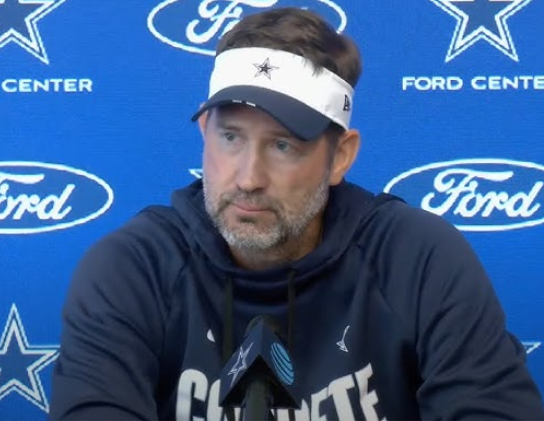
Sources close to the situation indicate that head coach Brian Schottenheimer is seriously evaluating whether the Cowboys should reconsider the future of running back Phil Mafah.
The issue reportedly goes beyond pure effort.
While Mafah has earned respect for his physical running style, toughness, and willingness to compete for difficult yards, questions about scheme fit and long-term roster balance have raised internal debate.
Dallas is not treating the situation as a simple performance conversation.
It is about identity.
Roster flexibility.
Offensive direction.
And whether every running back on the roster still matches what the Cowboys want their offense to become.
Mafah entered Dallas as a young back who understood that virtually every opportunity would have to be earned through patience and persistence.
He was never handed a secure role.
He was never treated like a guaranteed future star.
But his powerful frame and downhill running style gave the Cowboys an intriguing developmental option in a competitive backfield.
That physicality has provided Mafah opportunities to show what he can offer when Dallas needs a runner capable of attacking between the tackles.
His ability to absorb contact and continue moving forward gives him characteristics that can become valuable in short-yardage situations.
However, the Cowboys are now studying every roster spot with a colder eye.
The franchise understands that flexibility can open doors before final cuts, waiver claims, and late-summer trade discussions.
Moving on from a young player like Mafah would not be a simple decision.
It would come with risk.
It would remove a physical option from the backfield.
And it could mean giving up on a developmental player before Dallas has fully discovered what he might eventually become.
Still, Schottenheimer has made it clear that effort and potential alone will not be enough to guarantee any player’s role.
Speaking carefully but firmly, Schottenheimer addressed the broader standard without directly confirming any roster decision.
“We respect every player who comes into this building and fights for a role. But the standard here is bigger than effort alone. It is about consistency, execution, and whether every piece fits the direction we are building. If something does not match that, we have to protect the team first.”
Mafah remains intriguing because of his toughness and willingness to accept physical work.
His size gives Dallas a potential option in short-yardage situations.
He can provide depth, absorb difficult carries, and potentially contribute when injuries force adjustments elsewhere in the backfield.
But the Cowboys are trying to build more than emergency options.
Dallas wants an offense built on timing, physicality, versatility, and explosive possibilities.
That means every running back must fit not only the playbook, but also the larger offensive vision.
For Mafah, that could mean demonstrating that he can provide value beyond simply carrying the football between the tackles.
Pass protection, receiving ability, special teams contributions, and consistency during practice could become important factors when coaches begin making their final evaluations.
If Dallas ultimately decides to move on, the decision would send a clear message across the locker room.
It would show that the Cowboys are willing to challenge even promising young players if they believe the roster needs a sharper direction.
The move would not simply be about creating space.
It would be about setting a tone.
Potential does not guarantee security.
Physical talent does not erase evaluation.
And in Dallas, the standard under Brian Schottenheimer appears to be enforced at every level of the roster.